
The Benefits of Writing by Hand
by Lori Lehman
I was born in the early 1980s, which afforded me the opportunity to live life before and after modern technology. I remember talking to my friends on a phone attached to the wall in a phone nook with a very long cord, struggling to get privacy. But I also had computers, cell phones, and e-readers infiltrate my life in my teens and early 20’s. I have lived in both worlds and am just as comfortable working on a digital device as I am putting pen to paper. I have watched technology evolve into e-charts at my doctor’s office, digital textbooks, and tablets that allow you to take notes with a stylus. I see the benefits of going digital. It saves printing and paper, storage is much easier, and files are easy to share and access. But I also see a lot of value in keeping things in physical formats.
The world has been noticing a trend: students are learning and retaining less, and we are searching for answers so we can change the trajectory. A common theme is that the decline in academic performance may be linked to the ever-present digital technologies in our students’ lives and learning environments. The decline was pinpointed to the early 2000’s when computers began integrating into education. In 2007, most classrooms had a whiteboard. By 2009, 97% of classrooms had at least one computer in them, and by 2014 the world had purchased 23 million digital devices for classrooms. The global COVID pandemic only made these devices more prolific and necessary as students worldwide adjusted to distance learning.
This revolution into technology dominating our classrooms means that students are completing assignments, writing, researching, and even reading textbooks all on computers and tablets. Students are not completing assignments, taking tests, or taking notes with a pencil and paper. It is this link that researchers are investigating.
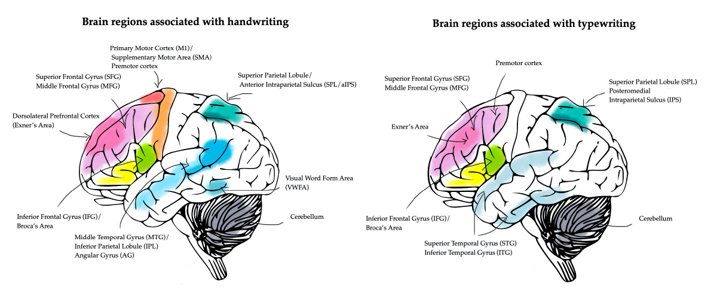
Giuseppe Marano and Marianna Mazza, and their colleagues wrote an article examining multiple studies on the subject. They discuss multiple cognitive benefits to handwriting over typing. When we write by hand, we engage multiple areas of the brain and utilize multiple skills. We use linguistic skills by turning spoken words into written words. We use our memory by holding the information long enough to translate it and write it down. Handwriting requires planning and the use of fine motor skills to accurately create the letters. We are simultaneously performing error detection for letter formation, spelling, and content. And we must analyze the information we are receiving and choose what to write since you cannot write down everything a person says, or as fast as our thoughts move. Typing uses some of these skills, except typing engages gross motor skills rather than fine. And it involves our brains less because we are not having to engage the linguistic skills as much. The study also noted some minor differences between writing in cursive and block letters.
The most positive fact to come out of this article is that writing on a touch screen with a stylus stimulates almost the same brain activity that writing on paper does. Scientists determined that writing by hand on a tablet offers lower kinetic stimulation than writing on paper, but it may engage the brain more in other visual ways. This allows us to continue receiving the benefits of technology while preserving the cognitive and learning benefits of handwriting.
So, writing by hand activates more of the brain than typing. But how does that help students learn? How will this help improve student academic performance? Research long ago discovered a link between learning/memory and motor skills. Yadurshana Sivashankar said in a 2021 study that “Drawing information and enacting information is helpful because you have to think about information and you have to produce something that’s meaningful.” This concept is the basis for the Lindamood-Bell programs used at the Fort Wayne Center for Learning. By asking students to air-write as they spell and do math, we are involving the motor cortex, which aids in learning and increases memorization of the information.
We receive so many benefits from the increased presence of technology in our lives. But we have a responsibility as parents, lawmakers, and educators to understand how that technology affects our lives and formulate how to work with technology in a way that brings growth and prosperity.